Over the past two years, thousands of Indian apparel brands experimented with AI fashion model generators. While the promise of ₹20 photoshoots instead of ₹25,000 studio sessions is compelling, many sellers noticed a frustrating reality: their traffic increased, but conversion rates plummeted.
Shoppers today are visual experts. They can spot synthetic 'uncanny valley' images instantly. When a customer suspects that a model photo is fabricated or doesn't represent the actual product, they don't buy — or worse, they order via COD, spot the discrepancy upon delivery, and reject the parcel.
The 5 Reasons Generic AI Model Images Kill E-Commerce Sales
- 1. Motif Drift & Pattern Hallucination
Generic AI tools don't transfer your exact print; they 're-imagine' it. A geometric Bandhani dot turns into random floral blobs, or an authentic Banarasi paisley turns into generic paisley mush. Buyers notice the difference immediately.
- 2. The 'Pallu on the Pleats' Disaster
In a saree, the pallu has a heavy, distinct artwork compared to the body. Generic AI tools average the fabric colors, placing heavy zari pallu motifs onto the front pleats or draping the plain body fabric across the shoulder.
- 3. Flat 'Sticker' Appearance (No Fabric Weight)
Simple background-swap tools cut out a flat garment photo and paste it onto a stock 3D avatar. The result looks stiff, with zero natural drape, pleat tension, or fabric folds matching the model's posture.
- 4. Plastic Skin, Distorted Hands & Uncanny Faces
Over-smoothed porcelain faces and mutated fingers instantly signal 'fake product'. High-intent shoppers equate fake model photos with dropshipping scams.
- 5. Blouse Fabric Confusion
When a seller uploads a saree fabric with an unstitched blouse piece attached, basic AI tools try to drape the entire piece — blouse border included — as one giant fabric, ruining the neckline and sleeve proportions.
How Dedicated Draping Architecture Solves the Conversion Problem
To achieve studio-grade conversion rates, an AI photography system cannot treat ethnic wear like a Western t-shirt. Vastralook built Drape Studio specifically around the physics and construction of Indian apparel:
| Feature | Generic AI Fashion Tools | Vastralook Drape Studio |
|---|---|---|
| Fabric Input | Single square crop (approximate) | Dual inputs: Primary Saree Fabric + Separate Blouse Fabric |
| Edge Boundary | Automatic fuzzy crop (misses borders) | AI Cut Loupe: 4-corner boundary nudge for exact fabric outline |
| Pallu Separation | None (random placement) | Interactive Pallu Marker Line (sets exact drape transition) |
| Pattern Repetition | Random stretching | Pattern Repeat Line guide for micro vs macro prints |
| Blouse Control | Prompt guess ('wearing blouse') | Adjust Blouse Pattern: shape, neck cut, and sleeve length |
| Quality Assurance | Automated only (errors charged) | Create Order: human QC review + 50% credits refund guarantee |
The Conversion Checklist for Indian Ethnic Wear Catalogues
- Ensure the saree border runs continuously along the pallu and hem without blurring.
- Verify the blouse neckline matches what the buyer receives in their unstitched package.
- Include at least one high-res close-up of the zari / thread weave to prove fabric authenticity.
- Use consistent model identity and lighting across Front, Profile, and Back shots.
- Maintain natural skin tones and believable studio shadows that match marketplace standards.
Do shoppers know when fashion photos are AI-generated?
Shoppers can easily identify poorly made AI photos (distorted hands, blurry borders, hallucinated prints). However, when generated with exact fabric edge detection, natural draping physics, and clean studio lighting, high-fidelity AI photos are virtually indistinguishable from traditional studio photoshoots.
How does Drape Studio prevent motif hallucination?
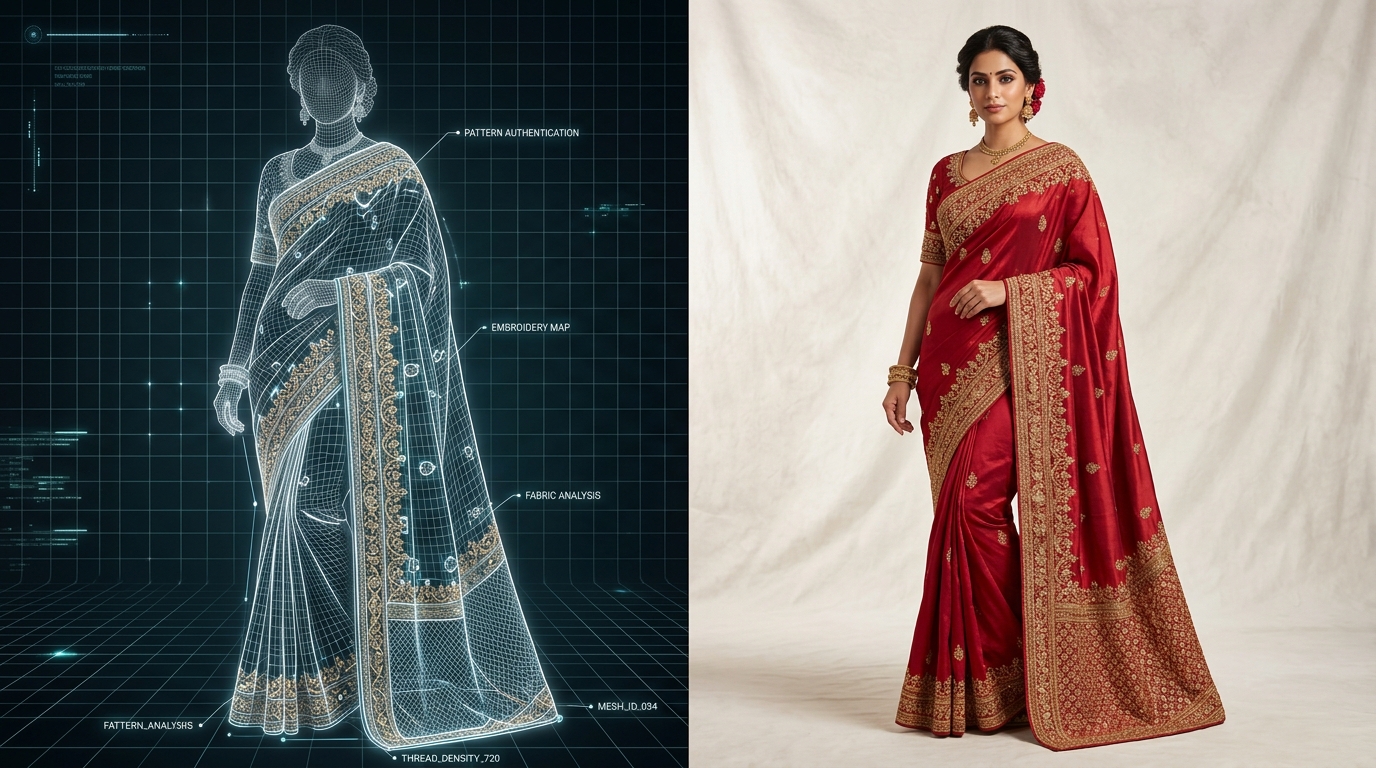
Drape Studio uses direct pixel mapping and structural condition adapters, locking the exact pattern, border geometry, and color profile from your source photo onto the 3D model form.
What if a generated image has a minor defect?
On Vastralook, you can either request team-delivered fulfillment through 'Create Order' (15–20 credits per shot, human checked) or use the 'Ask for half credits back' button to receive 50% of your credits refunded instantly.
Sources
- Inc42 — State of Indian D2C & Fashion E-commerce Returns (2025-2026) — Indian ecommerce return rate benchmark data; read October 2026
- Fynd Commerce — Myntra Image Requirements — Myntra listing guidelines; read October 2026
- Reliance AJIO Supplier Portal — Product Image & Listing Guidelines — AJIO's internal seller portal guidelines; read October 2026