When an online shopper opens a saree listing on Myntra, Amazon or a D2C Shopify store, the decision to stay or leave happens in less than 3 seconds. The best saree poses are the ones that answer a buyer's questions in that time: how does the drape fall, what does the pallu look like, and what will the back of the blouse be like? This post goes through the data Vastralook has reported on saree poses, explains what it means, and shows how to use it on your own listings.
What does the data say about saree poses?
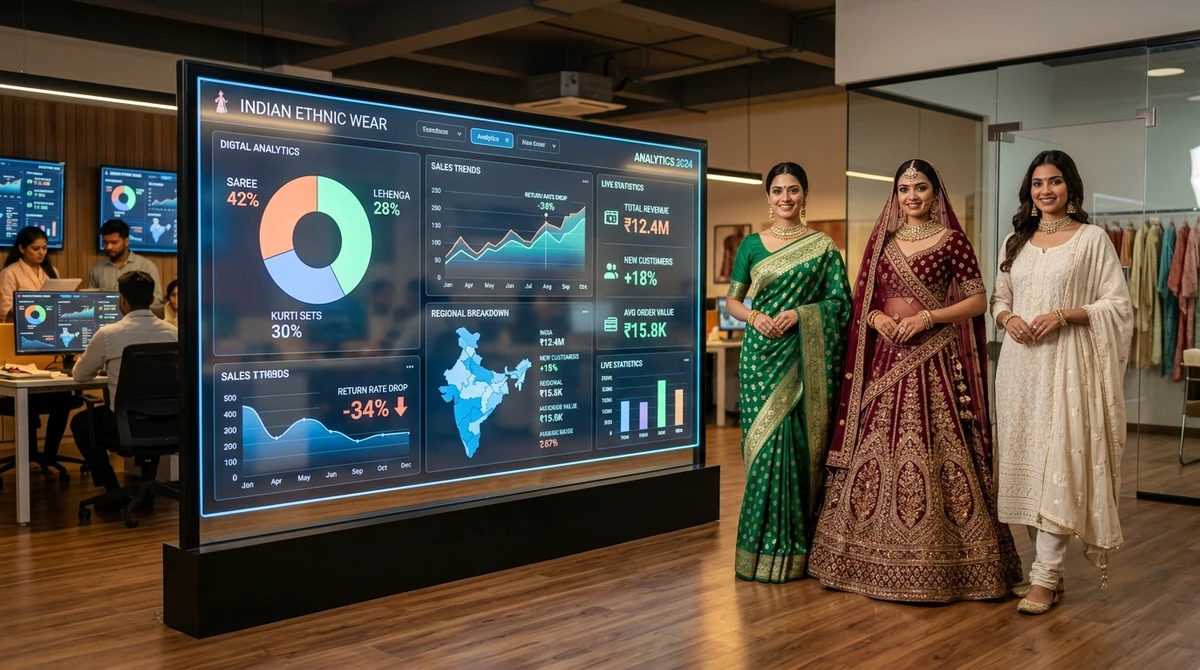
Three findings matter most. First, galleries beat single photos: single-photo saree listings are reported to see 2.4 times the return rate of galleries with four poses. Second, the pallu and the back are what buyers want to see: showing the pallu fall and the back blouse cut in your top three photos is reported to lift sales by 32 percent. Third, a Back View reduces questions: it is reported to cut blouse and sizing enquiries on WhatsApp by over 45 percent.
These numbers are the reported data from the original analysis. The reasoning behind them is easy to follow. A saree is a long piece of cloth, and a single front photo hides most of it. A shopper who cannot see the pallu, the back of the blouse or the border has to guess, and guessing leads to returns or to a message you have to answer.
What is the best four-pose sequence for a saree listing?
From the same analysis, here is the four-pose framework that balances conversion with fewer return disputes. Each pose has a job.
- 1. The clean Front Standing hero (the 0 to 1 second hook)
The model stands upright and faces the camera with good posture. The pallu is draped neatly over the left shoulder, so the entire body motif, the front pleats and the bottom border are fully visible.
- 2. The 45° side profile (fit and drape check)
The model is turned about 45 degrees. It shows the drape curve across the hip, the sleeve length and the armhole fit, without shadows.
- 3. The rear back angle (blouse and pallu tail)
Crucial for ethnic wear: it reveals the back blouse neck depth, the dori tassels and how far the pallu falls down the calf.
- 4. The zari and border close-up (quality reassurance)
A sharp, closer crop that shows the thread, the gold zari lustre and the weave texture.
Why does the front standing pose work as a hero?
The hero image is the one shown in search results and in the first slot on a listing, so it has to say everything in a glance. A front standing pose with the pallu over the left shoulder shows the colour of the body, the border, the pleats and the fall of the pallu together. It also matches what most people picture when they imagine wearing a saree, so it feels familiar, not experimental.
Amazon asks for full-length, head-to-toe hero images on a pure white background, so the Front Standing pose is the natural main image there. For Instagram ads and a Shopify hero banner, seated poses can add aspirational lifestyle storytelling, which is why they suit D2C better than a marketplace main image.
Which pose works for which saree fabric?
A pose is also a message about fabric. A stiff silk should look structured and a georgette should look like it moves. If the pose contradicts the fabric, buyers read the saree as something it is not.
| Fabric type | Best posing posture | Key feature to highlight | Trap to avoid |
|---|---|---|---|
| Kanjivaram / Banarasi silk | Formal standing, hands relaxed at sides | Rich metallic zari pallu and border stiffness | Curling or crushed pallu folds |
| Georgette / chiffon / crepe | Gentle walking stride or slight turn | Flowing drape softness and sheer translucency | Stiff rigid poses that make it look like cotton |
| Organza / tissue | Graceful stationary pose with natural light | Crisp structured volume and delicate lustre | Excessive wrinkles around the waist |
| Linen and handloom cotton | Contemporary clean standing pose | Raw natural texture, temple borders and matte finish | Over-smoothed, high-gloss lighting |
In Drape Studio the pose names you will see include Front Standing, Left Profile, Back View, Seated and Candid Stroll. A silk saree maps to Front Standing and Back View, a georgette to Candid Stroll, and a lifestyle post to Seated. Treat that as a starting point and check the shots, because the way a saree falls on a given pose can differ from your reference.
Why does the back view reduce questions and returns?
In India, a lot of saree selling still happens through chat. Every unanswered question on WhatsApp is a delay, and every unanswered doubt is a possible return. The most common doubts are the blouse back, the neck depth, the dori and the length of the pallu tail. A Back View answers all of them in one picture, which is why it is reported to remove such a large share of enquiries.
There is a second reason: trust. A seller who shows the back is a seller with nothing to hide, and shoppers notice. If your return reasons are mostly about the look not matching, a back view and a pallu close-up are the first things to add.
How do you use this in Drape Studio?
In Drape Studio you upload one photo of the full saree, set the pallu line, press Use this cut, and pick a model and a background from StyleMuse. Then open the Styles tab. It shows your saree on each pose, and every pose you tick is one shot. So a four-pose set is four ticks.
If you sell on a marketplace, the Marketplace card sets a pose list for you: tapping Myntra or Amazon picks 5 poses, and Flipkart or Meesho picks 3. That is a little different from the four-pose framework above, so treat the preset as a safe default for that marketplace and add or remove poses to match the sequence you want. The poses in a preset are Front Standing, Left Profile and Back View, with Seated and Candid Stroll added for Myntra and Amazon.
| Option | Poses | Size | Budget (credits) | Instant (credits) |
|---|---|---|---|---|
| Four-pose set at 2K | 4 | 2K | 40 | 60 |
| Myntra or Amazon preset | 5 | 2K | 50 | 75 |
| Flipkart preset | 3 | 2K | 30 | 45 |
| Meesho preset | 3 | 1K | 21 | 30 |
How do you test poses on your own listings?
Data from other sellers tells you what to try. Your own listings tell you what works for your buyers. A simple test needs no tools beyond what you already have.
- Pick two similar sarees
Choose two products of a similar fabric and price that currently sell at a similar pace.
- Change one thing
Give one saree the full set with a Back View and pallu shot, and keep the other as it is. Do not change the title or the price at the same time.
- Watch the right numbers
Note the questions you receive on WhatsApp about the back and the blouse, the orders, and the return reasons, over a few weeks.
- Keep what helps
If the extra poses reduce questions or returns, add them to the next ten products.
Remember that correlation is not proof. A seller with a full gallery may also have better descriptions, better prices and better service. That is another reason to test on your own listings.
What should you check on every generated saree shot?
- The pallu is on the correct shoulder and falls the way you would drape it.
- The body motif, border and pleats look like your saree.
- The blouse matches the blouse you are selling or the saree body, as you chose.
- The colour matches the real saree in daylight.
- The hands and face look natural, and the saree does not look stiff for a soft fabric.
Output varies, and pose, drape and fine detail can differ from the reference, so look at every shot before publishing. A shot that fails has its credits returned automatically, and for a shot that was made but missed you can ask for half the credits back from the Orders tab.
The takeaway on the best saree poses
The best saree poses are not the most dramatic ones. They are the ones that show the colour, the pallu, the border and the back clearly, and that suit the fabric. Start with Front Standing, a side profile and a Back View, add a closer crop of the zari or border, and test the set against your single-photo listings.
How many poses should a saree listing have?
The reported best practice is four: Front Standing, a 45 degree side profile, a back angle and a zari or border close-up. Marketplaces allow different numbers, so check the seller panel for the current rule.
Why do seated poses work well for D2C but not on Amazon?
Amazon asks for full-length standing head-to-toe hero images on pure white. On Instagram ads and Shopify hero banners, seated poses create aspirational lifestyle storytelling that drives engagement.
Which pose is best for a georgette saree?
A gentle walking stride or a slight turn, because it shows the flow and softness of the fabric. A stiff, rigid pose can make georgette look like cotton.
Does a marketplace preset create the four-pose sequence?
Not exactly. Myntra and Amazon presets pick 5 poses, and Flipkart and Meesho pick 3. You can add or remove poses to build your own sequence.
Why include a back view of a saree?
It shows the blouse back neck, the dori and the pallu tail, which are the most common doubts. It is reported to reduce blouse and sizing questions on WhatsApp by over 45 percent.