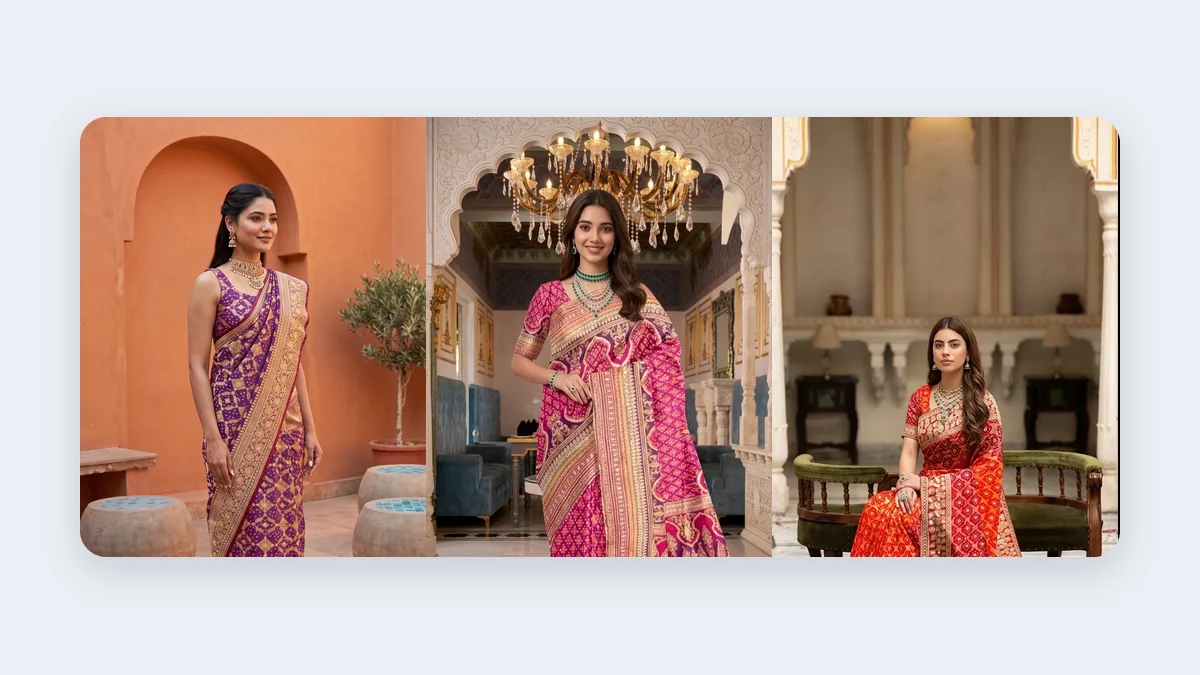
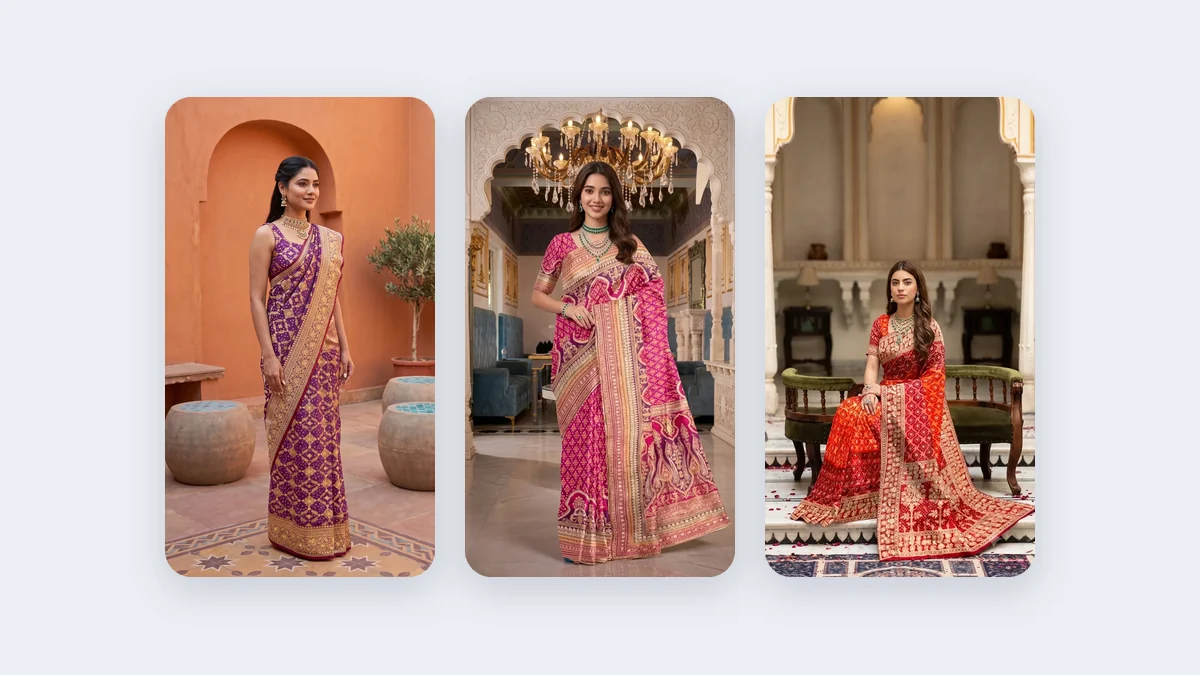
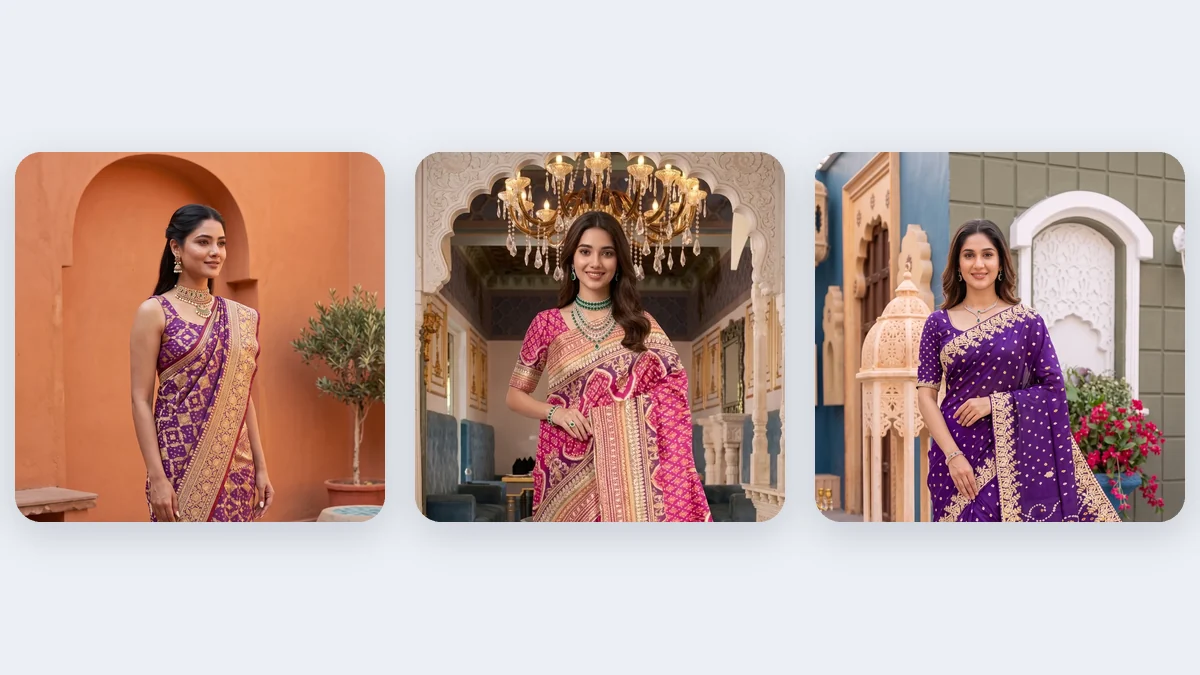
Want to see how a saree, lehenga or kurta looks on you before you buy? Or swap the outfit in a product photo without a reshoot? An AI dress changer lets you change clothes in a photo in seconds. It is one of the fastest-growing uses of fashion AI, and for good reason: it saves time for shoppers and money for sellers.
This guide explains what a dress changer is, how it works, how to get realistic results, the difference between free and paid tools, how sellers can use it, and the privacy and ethics you should keep in mind.
What is an AI dress changer?
An AI dress changer is an online tool that detects the person and clothing in a photo, then replaces the outfit with another garment image or a generated style. You may also see it called an AI clothes changer, photo outfit changer, online photo dress changer, cloth change in photo tool, clothing editor app, or virtual try-on.
The key idea: instead of editing pixels by hand, the AI understands body shape, pose and lighting, then draws the new garment so it fits naturally.
Who uses it?
| User | Why |
|---|---|
| Shoppers | Preview how an outfit looks before buying |
| Boutique owners | Show one garment on many models or poses |
| Fashion brands | Create catalogue images without reshoots |
| Content creators | Make fashion posts, mock-ups and styling reels |
| Designers | Test styles and colourways quickly |
| Tailors | Show customers a visual of a custom design |
How an AI dress changer works
- Upload a clear photo of the person. Front-facing, full body, good light and a simple background work best.
- Upload or choose the new garment. A flat-lay or product photo on a plain background gives the cleanest result. Some tools let you describe the outfit in text instead.
- The AI maps the garment to the body shape, pose and lighting, taking care of folds, shadows and edges.
- Review the result. Compare it to the original and your garment photo.
- Download or regenerate. Pick the best version or try another pose or crop.
Tips for realistic results
| Tip | Why it matters |
|---|---|
| Use a high-resolution, well-lit photo | More detail for the AI to work with |
| Avoid crossed arms or objects hiding the body | The AI needs to see the shape |
| Choose a clean garment photo | Fewer errors in print and shape |
| Match garment length and style to the pose | Dresses on seated poses look different from standing |
| Keep the background simple | Improves cut-out accuracy |
| Try more than one generation | AI results vary; pick the best |
| Check hands and edges at 100% | Most errors appear there |
Free vs. paid tools
| Feature | Free tools | Paid tools |
|---|---|---|
| Resolution | Often limited | Higher, print-ready |
| Watermark | Common | Usually removed |
| Daily limits | Common | Higher or unlimited |
| Commercial licence | Often restricted | Usually included |
| Speed | Slower queues | Faster |
| Support | Minimal | Available |
If you plan to use images for selling or advertising, check the licence and image quality first. A free dress changer online free is great for experimenting, but business use usually needs a paid plan with clear commercial terms.
Using a dress changer for ecommerce
For sellers, the dress changer replaces repeated studio sessions:
- Show one model in several colourways.
- Place a new garment on your existing model photos.
- Test which styles customers respond to before producing stock.
- Create social media content in minutes.
Before publishing, check these on every image:
- Print and border accuracy
- Colour match to the physical garment
- Hem length and neckline shape
- Hands, hair and background edges
Ethnic wear: sarees, lehengas, kurtas and dupattas
Draped garments are harder than fitted ones. A saree has pleats, a pallu and a border that must flow naturally. Lehengas have flare and layers. When testing a tool:
- Try a saree with a distinct border and see whether it stays intact.
- Check the pallu falls from the correct shoulder.
- Compare front and side views.
- Test a lehenga skirt for correct flare and length.
Vastralook focuses on apparel, including Indian ethnic wear, so these draping and fabric details are a priority. Upload your garment, pick a model and preview the result.
Troubleshooting common problems
| Problem | Likely cause | Fix |
|---|---|---|
| Garment looks flat or pasted on | Low-quality garment photo | Use a sharper, evenly lit image |
| Wrong colour | Poor lighting in source | Re-shoot garment in daylight |
| Distorted pattern | Complex print | Provide a closer, cleaner photo |
| Strange hands or edges | Occlusion or crossed arms | Use a photo with visible hands |
| Garment too short or long | Pose mismatch | Pick a standing, front-facing pose |
Privacy, consent and ethics
- Only edit photos you have the right to use.
- Never change someone's clothes without their consent.
- Be transparent when using AI images in advertising where required.
- Check where uploaded photos are stored and how long they are kept.
- Avoid uploading photos of children or sensitive images.
How a dress changer compares with other options
| Option | Strength | Limitation |
|---|---|---|
| Real photoshoot | Authentic, full control | Costly and slow |
| Manual photo editing | Precise | Needs skill and time |
| AI dress changer | Fast, scalable | Needs review for accuracy |
| Virtual try-on on your own photo | Personal preview | Shows look, not exact fit |
Best practices for sellers using a dress changer
If you sell clothing, use a dress changer as part of a repeatable process, not a one-off trick.
- Standardise your base model photos. Shoot one neutral pose with consistent lighting. Use that as the base for every garment.
- Create a garment photo routine. Photograph each product flat, on a plain background, with the same framing.
- Create a review checklist. Print, border, colour, hem, neckline, hands. Check each one before approving an image.
- Keep the original garment photo. Show both the on-model image and a plain product photo so customers can verify details.
- Track returns by image type. If AI images have higher return rates, tighten your review.
Example workflow for 20 new products
| Step | Time |
|---|---|
| Photograph 20 garments flat | 1 to 2 hours |
| Generate on-model images | A few hours |
| Review and select | 1 hour |
| Retouch and export | 1 hour |
| Upload to store | 1 hour |
Compare this with scheduling a studio, a model, a photographer and an edit queue, and the time saving is clear. Quality control stays your responsibility, so never skip the review step.
Dress changer vs. real try-on: setting the right expectations
A dress changer shows how a garment may look, but it cannot feel the fabric or measure your body. Treat it as a style preview, then confirm fit using the size chart, fabric description and customer reviews. For sellers, say clearly on the product page which images are AI-generated previews and which are photos of the physical product. This honesty protects your reviews and keeps returns low.
Conclusion
An AI dress changer is a quick way to visualise outfits and create product images. Use clear photos, review results carefully and respect privacy and consent. Ready to test it with your own garments? Try Vastralook and compare the results with your current images.
Frequently asked questions
Is there a free AI dress changer?
Yes. Several tools offer free trials with limits on resolution, watermarks or daily use.
Can it change the colour of clothes?
Many tools can recolour garments. See our guide to changing clothes colour online for free.
Does it work on sarees and lehengas?
It depends on the tool. Test with a garment that has complex drapes before relying on it.
Is it accurate for sizing?
It shows style and look, not exact fit. Always check the size chart.
Can I use the images commercially?
Check the tool's licence. Paid plans usually include commercial rights.
Will my photos be stored?
Read the privacy policy. Choose tools that let you delete uploads.