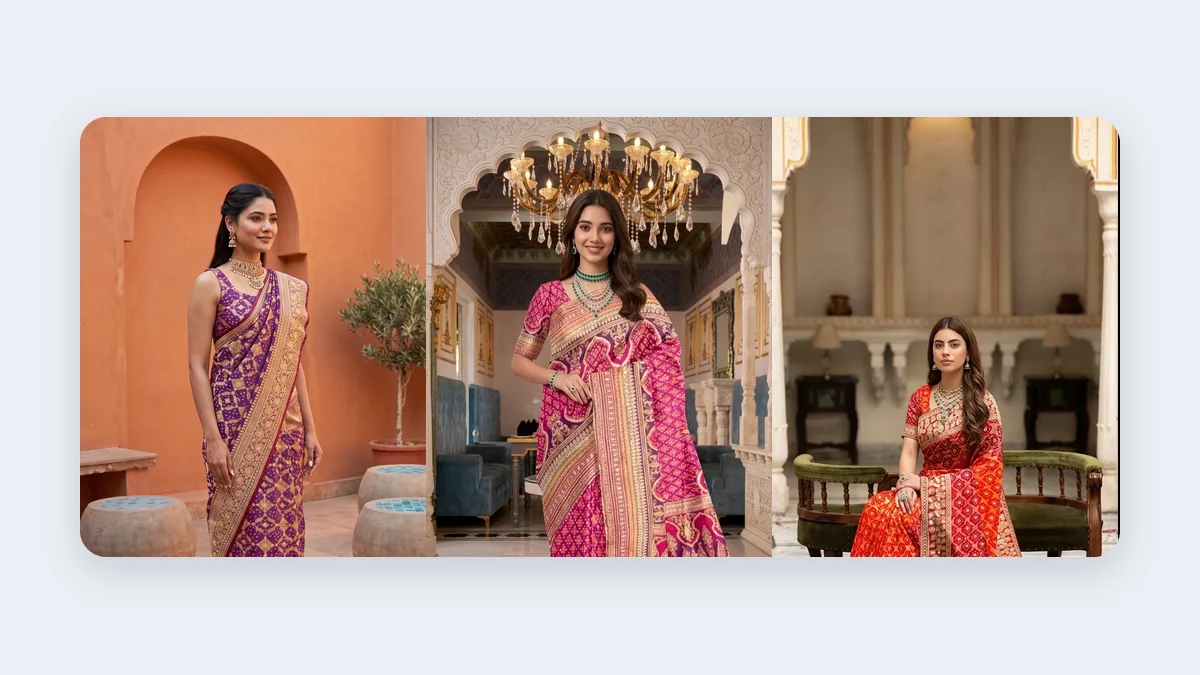
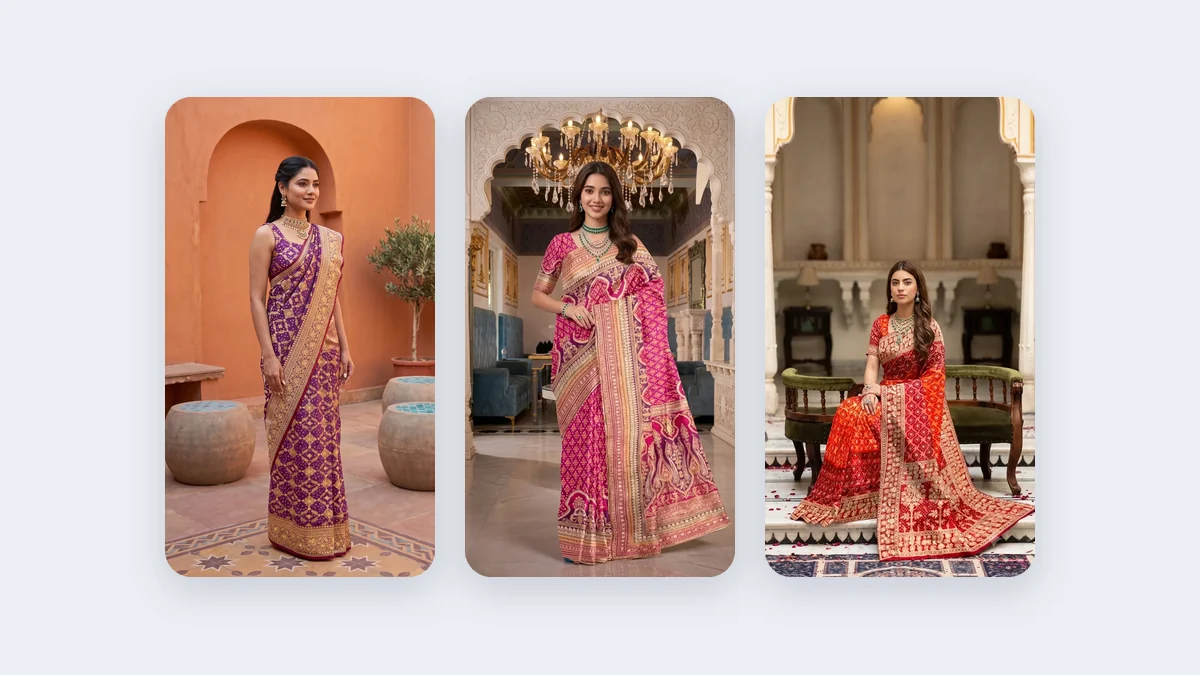
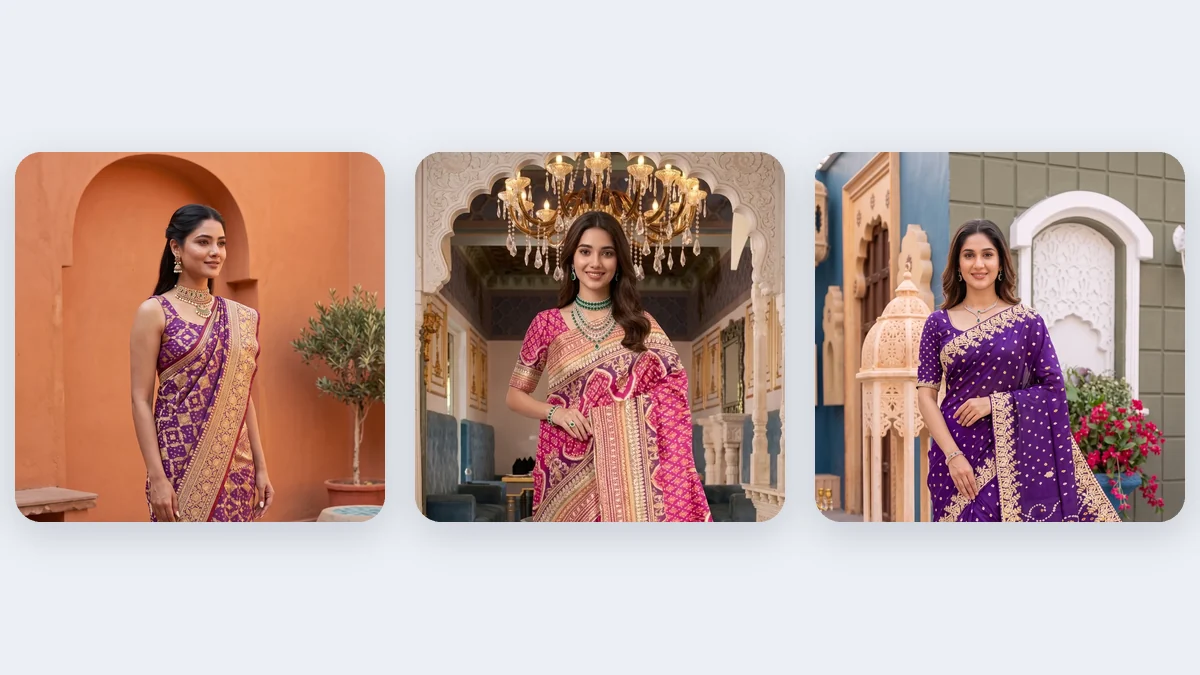
Advertising costs keep rising, so every rupee must work harder. The difference between a profitable and a wasted campaign is often the creative: the photo or video people see. This guide shows how fashion and ecommerce brands can build better ads, from catalog ads to AI-generated creatives.
Ad types ecommerce brands use
| Ad type | How it works | Best for |
|---|---|---|
| Catalog / dynamic ads | Automatically shows products from your feed | Retargeting and scaling |
| Single image ads | One strong visual | New collections and offers |
| Carousel ads | Several products or angles | Showing range |
| Video / reel ads | Motion and styling | Awareness and engagement |
| Shop ads | Links directly to product pages | Conversion |
Set up catalog ads properly
- Create a clean product feed with accurate titles, prices and availability.
- Use consistent, high-quality images with the product clearly visible.
- Group products into sets (e.g., festive wear, new arrivals).
- Exclude low-stock or low-quality items.
Image quality directly affects click-through rate, so invest in good photography.
What makes a fashion ad creative convert
- A clear subject on a clean or relevant background
- On-model images that show fit and drape
- A simple message: offer, new arrival or occasion
- Strong first frame for video
- Mobile-first framing (4:5 or 9:16)
- Real product accuracy to avoid returns
Photoshoot advertising: planning creatives
A marketing photoshoot should deliver several formats from one session: square, vertical and story-sized images, plus short clips. Plan the shot list around ad placements. Refresh creatives regularly to avoid fatigue.
Using AI-generated ads
AI can create variations of backgrounds, models and styling from your product photo, so you can test many ideas cheaply. Use Vastralook to produce on-model visuals and try different scenes, then test which ones perform best.
Guidelines:
- Keep the product accurate.
- Review every image before running ads.
- Follow platform advertising and AI disclosure policies.
Targeting basics
| Audience | Approach |
|---|---|
| Cold | Interests, lookalikes, broad targeting with strong creatives |
| Warm | Website visitors and social engagers |
| Hot | Cart abandoners and past buyers |
Metrics to track
CTR, cost per click, add-to-cart rate, conversion rate, return on ad spend (ROAS) and customer acquisition cost. Compare creatives, not just audiences.
Common mistakes
- Using poor or inconsistent product photos
- Sending traffic to a slow or confusing page
- Not testing creative variations
- Ignoring returns data when scaling
Platform-by-platform ad guide for fashion brands
Each platform rewards different creative and targeting.
| Platform | Strength | Best ad formats | Tips |
|---|---|---|---|
| Meta (Instagram and Facebook) | Visual discovery and retargeting | Catalog ads, carousels, reels | Use on-model images and short videos |
| Google Shopping and Performance Max | High purchase intent | Product feed ads | Optimise titles, images and feed quality |
| Google Search | Capturing active searches | Text ads with extensions | Target specific product keywords |
| YouTube | Awareness and storytelling | Short videos, shorts | Show styling and movement |
| Inspiration and planning | Shopping pins, idea pins | Great for ethnic wear and wedding planning | |
| Marketplace ads (Amazon, Flipkart, Myntra) | Shoppers already on the platform | Sponsored products | Strong main images and reviews matter |
| WhatsApp and email | Retention and repeat sales | Broadcasts, flows | Segment by past purchases |
Building a creative testing system
Treat creative as an experiment, not a guess.
- Create a hypothesis. For example: "On-model images convert better than flat lays for kurtas."
- Make two or three variations. Change one element at a time: image, headline or offer.
- Run with equal budget for a fixed period.
- Review key metrics: click-through rate, cost per purchase, ROAS.
- Scale winners and retire losers.
- Document learnings in a shared sheet.
Elements to test
| Element | Variations |
|---|---|
| Image | On-model vs flat lay vs lifestyle |
| Background | Studio, outdoor, festive |
| Model | Different looks and body types |
| Colour | Brand palette vs seasonal colours |
| Headline | Offer, feature, social proof |
| Call to action | Shop now, Explore collection, Get 10% off |
| Video hook | First 3 seconds with motion vs product reveal |
Ad copy formulas for fashion
Problem, solution, proof: "Tired of sarees that slip? Our pre-pleated lehenga saree stays in place all night. Loved by 1,000+ brides." Use only claims you can prove.
Occasion-led: "Diwali party outfits that photograph beautifully. Shop the festive edit."
Benefit-led: "Lightweight, breathable cotton kurtas for hot days."
Urgency (used honestly): "New collection, limited quantities."
Keep copy short, clear and relevant to the image.
Product feed optimisation for catalog ads
Your feed is the source of every dynamic ad.
| Field | Best practice |
|---|---|
| Title | Include brand, product type, colour, material, key feature |
| Description | Clear, factual, with fabric, fit and care |
| Image | High-resolution, main product visible, no clutter |
| Price and sale price | Accurate and updated |
| Availability | Auto-updated to avoid out-of-stock ads |
| Category | Use the platform's product taxonomy |
| Custom labels | Mark bestsellers, new arrivals, margins |
| GTIN or SKU | Provide where relevant |
Add multiple images per product so platforms can choose the best creative.
Budgeting and bidding basics
- Start with a modest daily budget and test several creatives.
- Let campaigns exit the learning phase before making big changes.
- Scale gradually, increasing budgets by small increments.
- Use broad targeting for prospecting if creatives are strong.
- Set up retargeting for visitors, add-to-cart users and past customers.
- Track profitability, not just revenue.
Key metrics explained
| Metric | Meaning |
|---|---|
| CTR | Click-through rate: how many clicks per impression |
| CPC | Cost per click |
| CVR | Conversion rate: purchases per visit |
| AOV | Average order value |
| ROAS | Revenue divided by ad spend |
| CAC | Customer acquisition cost |
| LTV | Lifetime value of a customer |
A healthy business needs ROAS and CAC that leave room for margin after product, shipping and returns.
Using AI to scale ad creatives
Creative fatigue is one of the biggest problems for fashion advertisers. Using AI can help:
- Generate multiple on-model variations from one garment photo.
- Test festive, minimal and lifestyle backgrounds.
- Produce seasonal visuals without a new shoot.
- Create image sizes for feed, stories and banners.
Vastralook is designed for apparel brands that want fast, on-model visuals. Always check that the garment's print, colour and shape match the real product, and follow each ad platform's rules about AI-generated content and accurate representation.
Landing pages that convert ad traffic
The ad gets the click, but the page makes the sale.
- Match the page to the ad's offer and imagery.
- Load fast on mobile.
- Show size chart, fabric details and shipping information above the fold or easy to find.
- Include reviews and user photos.
- Offer simple checkout and multiple payment options.
- Add reassurance such as return policy and secure payment badges.
Seasonal advertising calendar
| Period | Opportunity |
|---|---|
| January to February | Republic Day, winter wear, wedding season |
| March to April | Holi, summer collections, festive wear |
| May to June | Summer, vacation outfits, wedding peak |
| July to August | Monsoon, Raksha Bandhan, Independence Day |
| September to November | Navratri, Durga Puja, Diwali, wedding season |
| December | Year-end parties, winter weddings, gifts |
Plan creatives at least a month in advance so you can test and refine.
Compliance and ethics
- Do not exaggerate product quality or discounts.
- Follow advertising standards in your country.
- Respect platform policies about prohibited claims and imagery.
- Disclose AI-generated or edited images where required.
- Use customer photos and testimonials only with permission.
Quick checklist
- Clean product feed with quality images
- At least three creative variations
- Clear goal and KPI for each campaign
- Retargeting audiences set up
- Landing pages tested on mobile
- Budget and scaling rules defined
- Weekly review of results
Conclusion
Great ads begin with great images. Plan creatives, test variations and keep the product representation honest.
Frequently asked questions
What are catalog ads?
Ads that pull products from your catalogue feed and show them to relevant users.
How do I advertise my shop online?
Combine social ads, search ads, marketplaces and email, all supported by strong product imagery.
Can AI-generated images be used in ads?
Often yes, but follow each platform's policies.