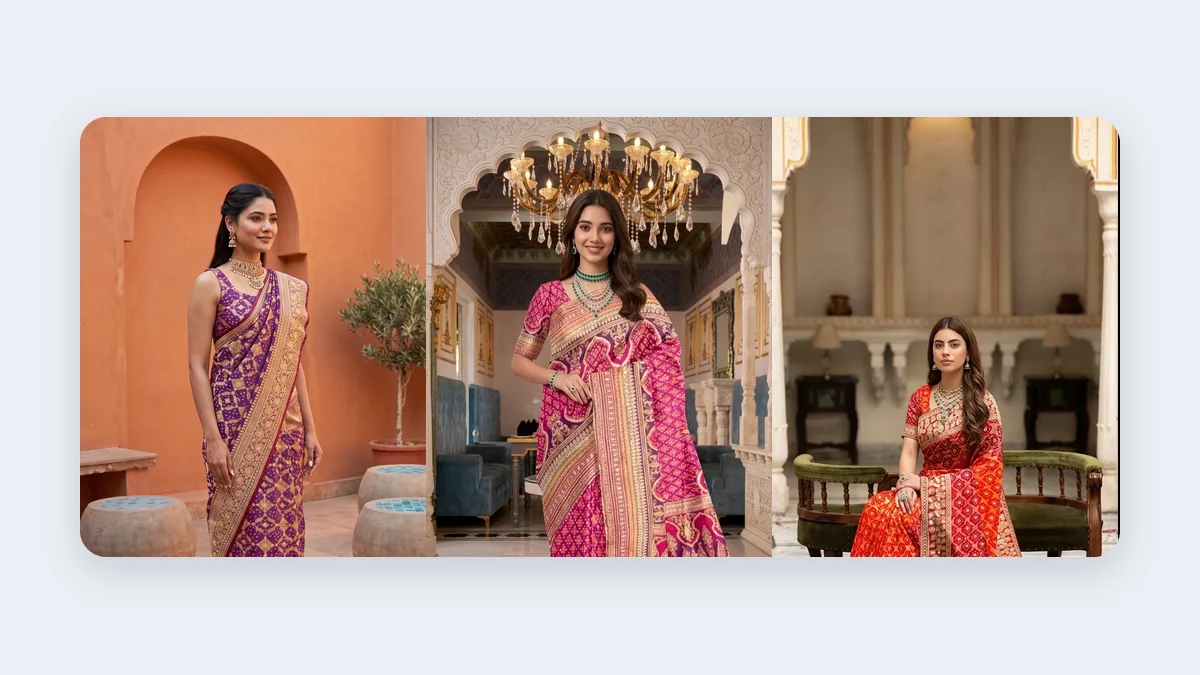
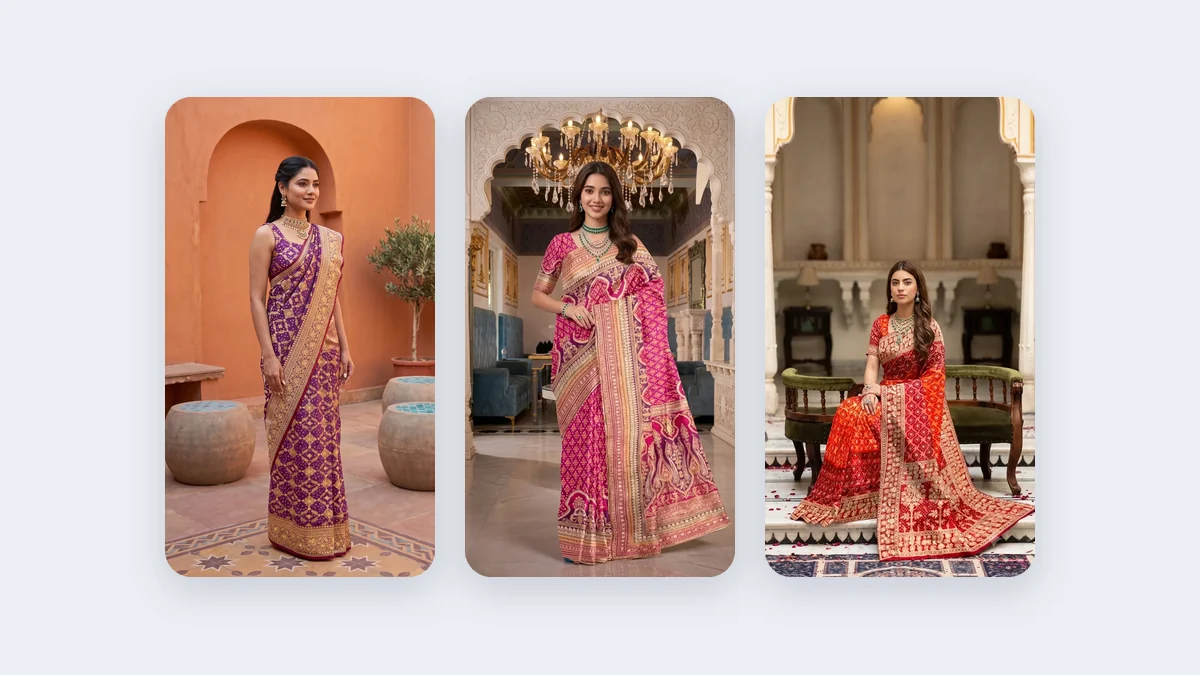
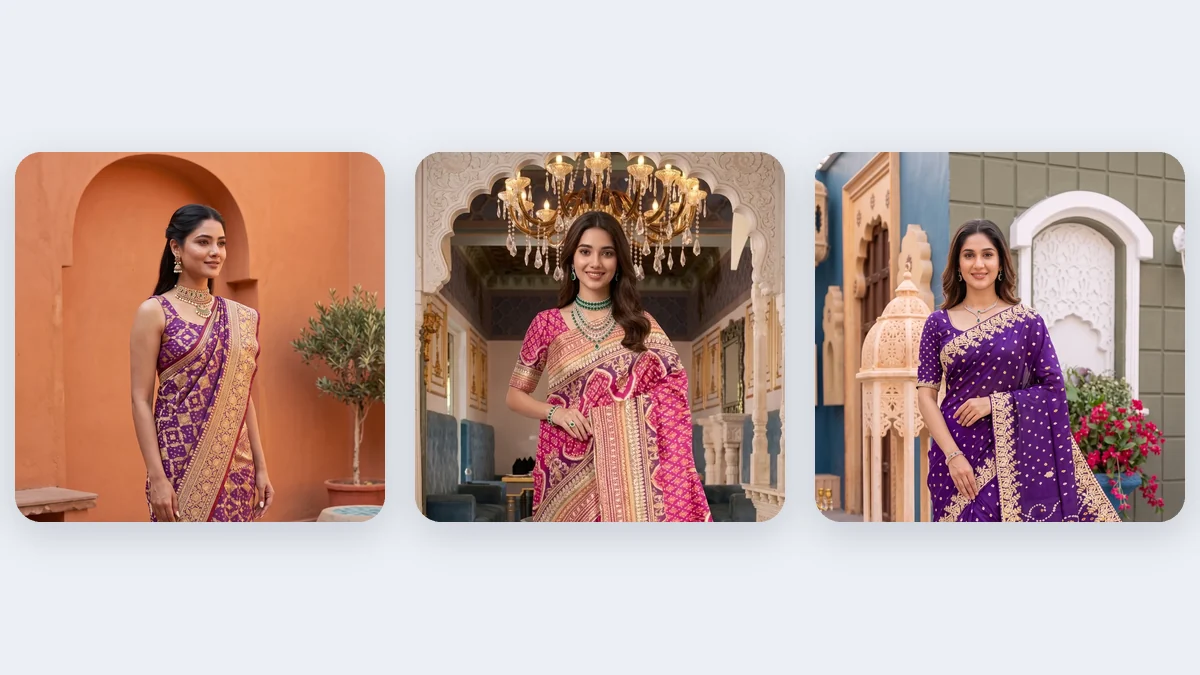
The right photoshoot background can turn an ordinary photo into something professional. The wrong one distracts from your subject. This guide covers backdrop types, colour choices, DIY and free options, and how to replace backgrounds digitally.
How to choose a background
Ask three questions:
- What is the purpose? Marketplace listing, social media, ad, or portfolio?
- What colour is the subject? Pick a background with contrast.
- What mood do you want? Clean and premium, warm and festive, or bold and editorial?
Popular backdrop types
| Type | Look | Best for |
|---|---|---|
| White seamless | Clean, neutral | Marketplace product photos |
| Light grey | Soft, premium | Fashion catalogues |
| Coloured paper | Bold, branded | Social media, campaigns |
| Textured wall or fabric | Warm, artisanal | Ethnic wear, handicrafts |
| Wood or marble surface | Natural, upscale | Flat lays, accessories |
| Outdoor greenery | Fresh, lifestyle | Fashion and portraits |
| Heritage architecture | Rich, traditional | Bridal and ethnic fashion |
Colour pairing tips
- Red or maroon outfit: cream, beige or soft gold.
- Pastel outfit: slightly darker muted tone.
- Black outfit: light grey or warm neutral.
- White product: light grey with a subtle shadow so edges are visible.
- Avoid backgrounds close to the subject's colour.
Free and low-cost options
- A plain wall painted off-white.
- A bedsheet or fabric steamed and clipped.
- Large poster boards from a stationery shop.
- Window light with a white curtain.
- Wooden table or tray as a surface.
Background design tips
- Keep it simple. The subject must stay the star.
- Add depth with a gentle gradient or soft blur.
- Keep consistent backgrounds within a collection.
- Leave space for text if the image will be used in ads.
Changing the background digitally
Software can remove and replace backgrounds, helpful when you shot against a plain wall but need white for a marketplace or a themed scene for a campaign. Check edges around hair and sheer fabrics. AI tools such as Vastralook can place your garment on a model in a chosen scene without needing a physical set.
Common mistakes
- Wrinkled backdrop fabric.
- Shadows on the background wall.
- Colour reflections from a bright backdrop onto the subject.
- Cluttered backgrounds that compete with the product.
Backgrounds by purpose: a practical selection guide
Choose the background from your end use, not just your taste.
| Use case | Recommended background | Why |
|---|---|---|
| Marketplace main image | Pure white | Platform rules and clean focus |
| Own website product page | Light grey, soft cream or brand colour | Looks premium and consistent |
| Instagram feed | Textured or coloured backdrops | Stands out in a grid |
| Ads and banners | Plain with space for text | Easy to add copy |
| Lookbook | Location, architecture or styled set | Tells a story |
| Portrait and headshot | Neutral grey, blue or blurred office | Professional look |
| Festive campaign | Warm tones, lights, flowers | Seasonal mood |
| Bridal | Heritage walls, soft pastels | Elegant and timeless |
Building a DIY backdrop step by step
Paper or fabric backdrop
- Buy a roll of seamless paper or a wrinkle-free fabric in white, grey or a colour of your choice.
- Clamp it to a stand or tape it high on a wall.
- Let it curve down to the floor and extend across the table, so there is no visible seam.
- Place the subject at least a metre away from the backdrop to reduce shadows.
- Light the subject and the background separately for clean results.
Painted wall
- Choose a matte paint in off-white, warm grey or a muted colour.
- Paint a smooth wall section at least two metres wide.
- Avoid glossy paint, which causes reflections.
Textured backdrops
- Plaster or lime wash: warm, artisanal look.
- Wooden panels: good for rustic or traditional settings.
- Marble sheet: adds luxury for flat lays.
- Brick or stone: gives an urban feel.
Lighting the background
| Lighting goal | Technique |
|---|---|
| Pure white background | Light the backdrop with two lights and expose it about one stop brighter than the subject |
| Soft gradient | Place a light behind the subject, pointing at the backdrop |
| Dark mood | Keep the backdrop out of the light and use a dark fabric |
| Coloured glow | Use a coloured gel on a background light |
| Remove shadows | Move the subject away from the wall and add fill light |
Changing the background digitally
If you shot on a plain wall but need a different scene, modern tools can remove and replace the background.
Steps
- Shoot with clear separation between the subject and the background.
- Use an AI background remover or selection tool to cut out the subject.
- Check edges around hair, dupattas and sheer fabrics.
- Place the subject on the new background.
- Match lighting direction, colour and shadows.
- Add a soft shadow beneath the subject to avoid a floating look.
Quality checks
- Is the edge clean without halos?
- Do shadows match the new background?
- Is the colour temperature consistent?
- Does the scene make sense in perspective?
AI-generated photoshoot backgrounds
AI tools can create backgrounds such as palace courtyards, studio sets, gardens or festive scenes. Vastralook can place your garment on a model in a chosen scene without needing a physical set, making it simple to test several settings for the same product. Always check that the product itself remains accurate, even if the scene is generated.
Free and legal background resources
- Create your own backdrops from walls, fabrics and paper.
- Use free-to-use stock sites, but always read the licence terms.
- Shoot your own textures, for example walls, wood and fabrics, and reuse them.
- Check whether AI-generated backgrounds can be used commercially.
Background mistakes that make photos look amateur
| Mistake | Fix |
|---|---|
| Wrinkled fabric backdrop | Steam or iron before shooting |
| Visible seam or horizon line | Use a seamless curve |
| Mixed colour temperature | Turn off room lights, use consistent light sources |
| Busy, cluttered scene | Remove objects and simplify |
| Subject too close to the wall | Move forward at least one metre |
| Backdrop colour reflecting on skin | Move the subject away or use a neutral backdrop |
Backgrounds for specific industries
- Fashion: neutral studio, locations, or textured walls.
- Jewellery: white, black or velvet with soft gradients.
- Food: wooden boards, marble, linen cloths.
- Electronics: gradient greys and clean white.
- Home decor: styled room sets.
- Beauty: soft pastel or glossy surfaces.
Quick checklist
- Background suits the final use
- Backdrop is clean, wrinkle-free and seamless
- Subject is far enough from the wall
- Lighting is consistent
- Colour harmony between subject and background
- Edits checked for clean edges and realistic shadows
Pro tips for backdrop care and reuse
Store paper backdrops rolled, not folded, and keep fabric backdrops steamed and hung. Mark the floor where your subject and tripod stand so every shoot repeats exactly. Keep a few spare clamps, tape and a lint roller nearby. If your background shows marks, wipe gently or cover that area with a fresh section. Photograph a quick test frame at the start of every session to catch colour casts or wrinkles early. A neat, well-lit background saves editing time and makes your photos look consistent across seasons.
Conclusion
Start with a simple, consistent background and let your product stand out. Experiment with colour and texture for campaigns once the basics are strong.
Frequently asked questions
What size should a backdrop be?
For full-length shots, a width of about two to three metres and height of three metres is comfortable. For tabletop products, a one-metre sweep is usually enough.
Can I use a green screen?
Yes, but it needs even lighting and distance from the subject to avoid green spill. For fashion, a plain neutral backdrop usually gives cleaner edges around sheer fabrics and hair.
How do I keep a white background truly white?
Light the backdrop separately and expose it slightly brighter than the subject, then fine-tune levels in editing.
What is the best colour for a product background?
White or light grey for most categories.
Can I get free photoshoot backgrounds?
Yes, use plain walls, fabric or free-to-use stock backdrops, and always check licence terms.
How do I avoid shadows on a backdrop?
Move the subject away from the backdrop and light them separately.