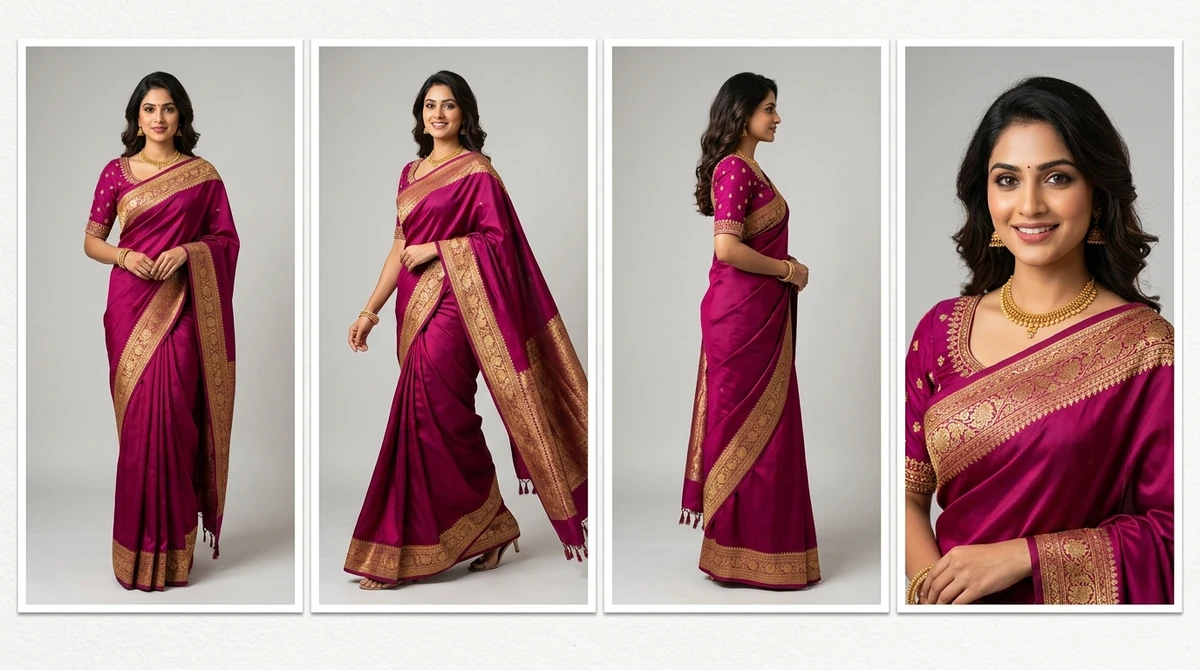
This ethnic wear catalogue data comes from Vastralook's own studios. Over the past three quarters, Vastralook processed more than 10,000 on-model photoshoot generations for more than 2,400 Indian textile manufacturers, wholesale traders, D2C brands and boutique resellers across Surat, Jaipur, Mumbai, Varanasi and Bengaluru. We looked at the anonymised aggregate: which garments dominate, which poses are chosen, how sellers use the blouse slot and how they set up for different sales channels.
Below are the numbers, followed by what we think they suggest for your own catalogue, and a section on the limits of the data. We have kept the interpretation separate from the figures, so you can reach your own conclusions.
Which garments do Indian brands shoot most?
| Garment category | Share of generations | Primary sales channel | Key visual priority |
|---|---|---|---|
| Sarees (silk, cotton, georgette, organza) | 48.2% | Marketplaces, WhatsApp, D2C | Pallu fall, pleat crispness, border alignment |
| Salwar suits and kurti sets | 22.4% | Myntra, AJIO, Meesho | Dupatta drape, yoke embroidery, sleeve length |
| Bridal and festive lehengas | 14.1% | Instagram D2C, boutique lookbooks | Skirt flare volume, heavy zari reflection |
| Western and Indo-Western dresses | 10.8% | Shopify stores, Amazon | Clean torso fit, neckline clarity |
| Co-ord sets and traditional men's wear | 4.5% | Festival drops, B2B lookbooks | Fabric texture, coordinate balance |
Adding two rows together: sarees and lehengas, the two garments that go through Drape Studio, make up 62.3% of generations. The remaining 37.7% is everything that goes through Catalogue Studio. Both studios are well used, and the sarees alone are close to half the work.
The Key visual priority column is worth reading as a checklist for your own review. For a saree it is the pallu, the pleats and the border; for a suit it is the dupatta, the yoke and the sleeve; for a lehenga it is the flare and the zari; for a dress it is the fit and the neckline. Whatever you shoot, look at those details first when you check each result, because the output varies and pose, drape and fine detail can differ from your reference.
How many saree sellers use a separate blouse photo?
In traditional Indian saree commerce, most premium sarees are sold with an unstitched blouse piece of about 80 cm. Our data shows that 64.1% of saree creators use the separate Blouse Fabric slot in Drape Studio, rather than letting the blouse be made from the saree itself. It is a clear sign that buyers want to see the blouse that comes with the saree, and not a generic top.
Which poses do sellers choose most?
| Pose style | Share of shots | Why sellers choose it |
|---|---|---|
| Front standing (full length) | 42.5% | The standard hero image for a listing |
| 45 degree side profile | 27.8% | Shows blouse sleeve fit, waist curve and pallu slope |
| Back view | 16.2% | Displays the back blouse cut, dori ties and rear pallu fall |
| Seated and candid stroll | 13.5% | Lifestyle imagery for Instagram and D2C |
Front standing and side profile together are 70.3% of shots. That is consistent with how the marketplace presets in Drape Studio are built: the Myntra and Amazon presets set five poses (front standing, left profile, back view, seated and candid stroll), and the Flipkart and Meesho presets set three (front standing, left profile and back view).
The last row, seated and candid stroll, is the lifestyle pair. Sellers choose it for Instagram and D2C pages, where the image is meant to feel less like a catalogue and more like a moment. If you sell mainly on marketplaces, it is the first row to drop when you want to save credits, and the first to add when you build a social feed.
Which marketplace presets and image sizes are used?
When creating marketplace catalogues, sellers use presets in Drape Studio that set the poses, background, model and image size for the marketplace. The share of preset selections was as follows.
On image size, 58.2% of users generate at 1K for quick WhatsApp line sheets and Instagram feeds, while 41.8% choose 2K or 4K for marketplace listings where shoppers zoom in. Size also changes the cost: Budget orders cost 7 credits at 1K, 10 at 2K and 15 at 4K, and Instant orders cost 10, 15 and 20.
One plausible reading, and it is only a reading: marketplace listings call for a preset and a larger size, while WhatsApp and Instagram work suits smaller, faster looks. They are different jobs, and a brand that sells in both places usually does both: quick 1K looks to decide, larger sizes for the listings that matter.
What can you do with this data?
These are our readings, not findings. Treat them as ideas to test against your own results.
- If you sell sarees, plan your shot list around the front, side and back before anything else. These are the three poses the data puts first, and the poses that show the pallu and the blouse.
- Treat the blouse as part of the product. If most saree sellers upload a blouse fabric, shoppers are likely to expect to see one. Keep the blouse photo cropped tight so that it does not carry the saree's border onto the blouse.
- Match size to use. Test looks at 1K, which costs less, and re-run the ones that go on a listing at 2K where zoom matters.
- Do not copy a preset blindly. A preset is a starting point: you can change the poses, background, model or size after picking one. Check the marketplace's own seller panel for the current image rule in your category.
- For lehengas, spend the extra shots on a close-up of the zari and a view that shows the flare, because the data lists those as the key visual priorities.
What are the limits of this data?
A fair reader should ask what these numbers can and cannot say. We list the main limits.
- It describes Vastralook users, not the whole market. Sellers who use an AI photo studio are not a random sample of Indian fashion sellers.
- A share of generations is not a share of sales. A garment can be generated often and sell rarely, or the reverse.
- Presets shape behaviour. If a preset sets five poses, those poses will show up often in the data, and a high count does not prove that they are the best choice.
- The sleeve-length figures come from sellers who customised the blouse, not from all sellers.
- Percentages are rounded and describe January to September 2026. Patterns can change with the festival and wedding season.
How was this dataset collected?
It is compiled from more than 10,000 anonymised generation logs across Vastralook's Drape Studio and Catalogue Studio between January and September 2026. No individual seller or garment is identified.
Can other publications cite this data?
Yes. Publications and industry reports may cite these statistics with a link back to this page.
Does this data represent the whole Indian ethnic wear market?
No. It shows how Vastralook users work, which is a useful picture of a group of online sellers but not the whole market. Use it as a guide and test it against your own catalogue.
Which marketplace preset is most used?
Myntra at 34.2% of selections, followed by Amazon (28.1%), Meesho (21.9%) and Flipkart (15.8%).
Should I generate at 1K or 4K?
Most users in this data (58.2%) use 1K. Use 1K to test looks and for WhatsApp and social posts, and use 2K or 4K for listings where shoppers zoom in. Larger sizes cost more credits.