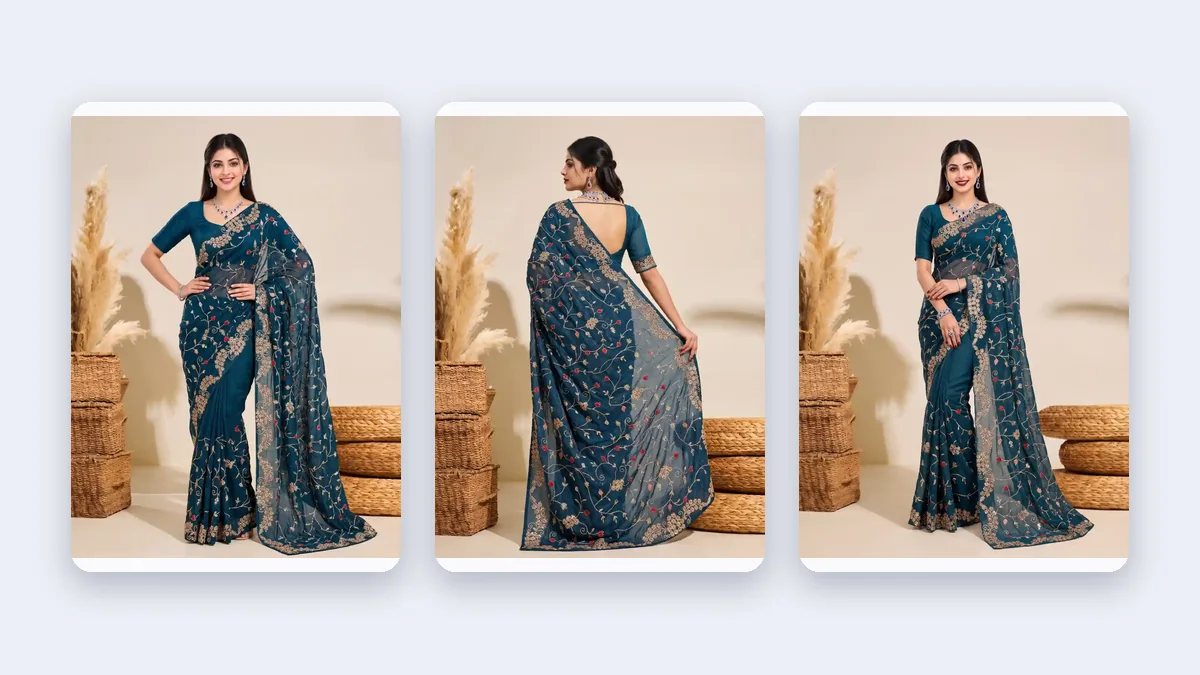
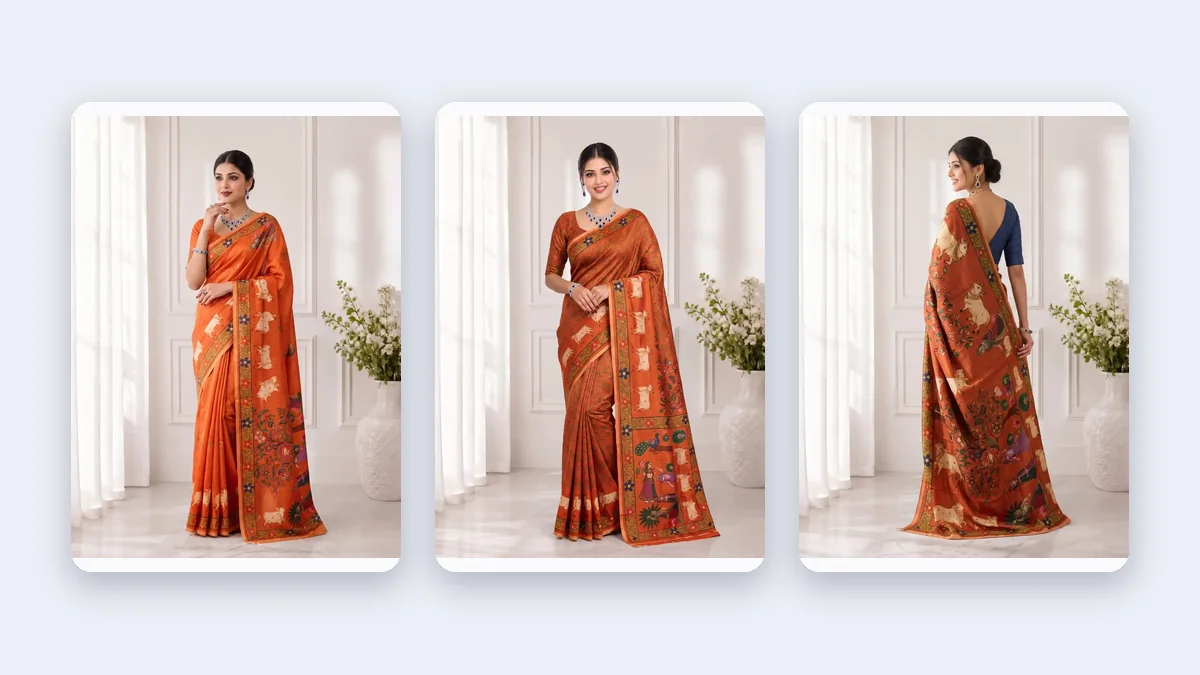
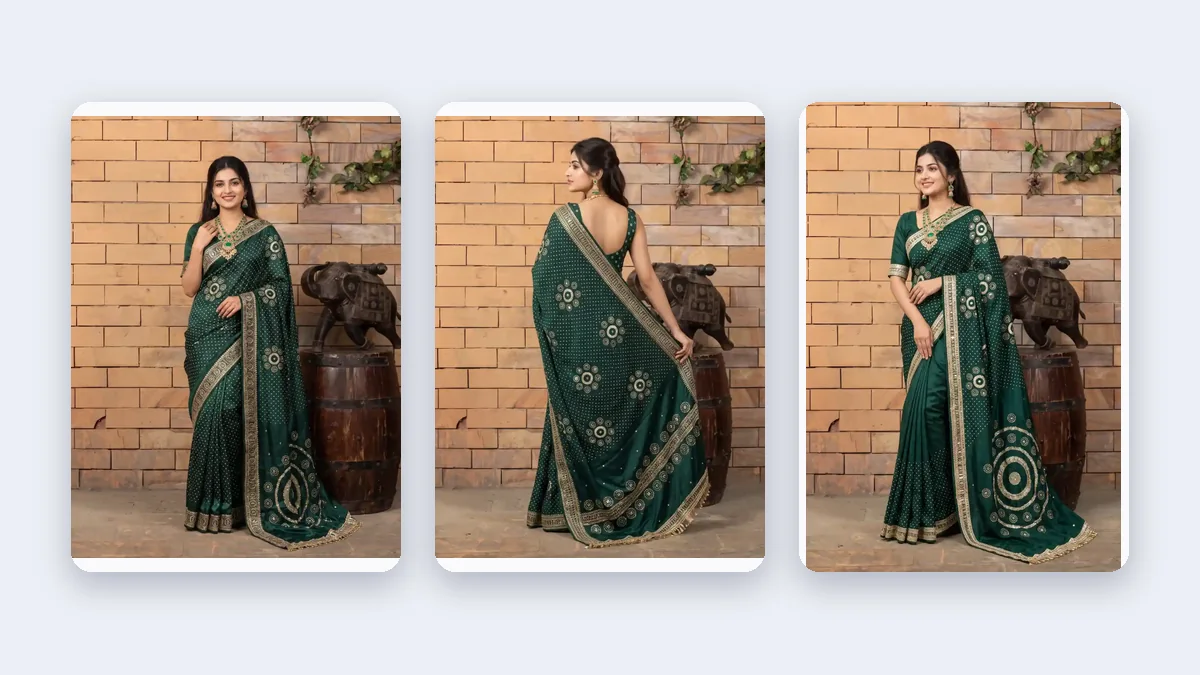
For years, apparel sellers relied on ghost mannequin photography to create clean catalogue images: shoot the clothes on a plastic dummy, then edit out the neck and arms so the garment appears to float. Today the ghost mannequin vs AI model question is a live one for Indian sellers, because marketplaces and shoppers increasingly want to see a garment on a body that proves fit, movement and silhouette. This guide compares the two approaches honestly, explains what to check with each marketplace, and shows how to move an existing catalogue to on-model images.
What is a ghost mannequin, and why do sellers use it?
A ghost mannequin, also called an invisible or hollow mannequin, is a technique where the garment is photographed on a dummy and the dummy is removed in editing. Often two photos are shot, one front and one of the inside of the neckline and back, and combined so the garment looks three-dimensional and filled out, with no body.
Sellers like it because it is clean and consistent. The same dummy can be reused, no model needs hiring, and the result looks tidy next to a plain background. It works well for shirts, tops, jackets and other stitched garments with a clear shape. It is also a natural fit for a close view of the neckline or collar.
Ghost mannequin vs AI model: how do they compare?
| Ghost mannequin | AI on-model stills | |
|---|---|---|
| What the shopper sees | A garment with no body | The garment on a model, in a pose |
| Shows drape and movement | Only a fixed, stuffed shape | Shows how it falls, within the limits of the output |
| Shows fit on a body | No | Yes, on the model chosen |
| Needs | A mannequin, two shots and editing | A good garment photo and a batch order |
| Draped garments (saree, dupatta) | Very hard | Handled in Drape Studio |
| Different body types | No | Choose models by body type, region, age and skin tone |
| Risk | Looks sterile or stiff | Output varies, so each shot needs checking |
What do Indian marketplaces expect from the main image?
This is where sellers get caught out, so be careful. Many Indian fashion marketplaces ask for, or strongly prefer, a model wearing the garment in the main image for adult apparel. Some categories, and some secondary gallery slots, accept other styles such as flat or ghost mannequin views. The details differ between Myntra, Amazon, Flipkart, Meesho and others, differ by category, and change over time. We do not quote exact limits here because they go out of date.
To save you setup time, Drape Studio's Marketplace card has presets that fill in a common starting point. They are a starting point, not a guarantee of approval, and you can change anything afterwards.
| Marketplace preset | Poses | Background | Model | Size and shape |
|---|---|---|---|---|
| Myntra | 5: Front Standing, Left Profile, Back View, Seated, Candid Stroll | Light Grey Studio | Indian Model | 2K, 3:4 portrait, JPEG |
| Amazon | 5: Front Standing, Left Profile, Back View, Seated, Candid Stroll | Pure White Studio | Indian Model | 2K, 3:4 portrait, JPEG |
| Flipkart | 3: Front Standing, Left Profile, Back View | Light Grey Studio | Indian Model | 2K, 3:4 portrait, JPEG |
| Meesho | 3: Front Standing, Left Profile, Back View | Light Grey Studio | Indian Model | 1K, 3:4 portrait, JPEG |
Why does ghost mannequin struggle with Indian ethnic wear?
- Sarees and draped garments have no fixed shape
A saree has no armholes or stitched form. Wrapping one around a hollow mannequin looks rigid and unnatural, and it fails to show the flow of the pallu and the pleats, which is what buyers judge.
- Heavy lehengas and gowns need volume and line
A can-can skirt, a flared anarkali or a trailing dupatta depends on how it falls on a body. A dummy shows a static outline and hides how the garment moves.
- The invisible body detaches the buyer
Fashion buying is emotional: shoppers imagine themselves in the outfit. A hollow floating garment feels commercial rather than aspirational, and it gives no sense of scale or height.
- The process is slow
Shooting a front and an inner view, clipping paths and stitching the composite takes editing time on every product. Multiply that by a drop of new designs and the work piles up.
Where does ghost mannequin still win?
It would be unfair to write it off. Ghost mannequin is still a good choice when you need a precise view of how a stitched garment is built: a collar, a neckline, a lining, the inside of a jacket. It is also useful as a secondary image next to on-model shots, because it shows the garment without distraction. And if you already have a clean set of ghost mannequin photos for stitched pieces, you do not have to throw them away.
What it cannot do is replace the on-model image where the marketplace or the shopper expects one. Use it as the supporting actor, not the lead.
How do you move an existing catalogue to AI on-model shots?
You do not need to reshoot old inventory from scratch. The studio works from a photo of the garment, so the question is whether your existing photo is good enough to be the source.
- Gather your existing photos for the garments you want to refresh. A clean front view with the garment fully visible, square-on, on a plain background, is the best candidate.
- Reject photos where the garment is stretched, cropped, bent or heavily shadowed. The output copies the shape and shadows it is given.
- In Catalogue Studio, add the front photo with Add a garment. If you have a back or detail photo, add those too, up to 4 images of the same piece.
- Pick the models and styles in the Models and Styles tabs, then check the Summary tab for garments x models x styles.
- Run one garment first, compare each shot with the real piece, and then run the rest of the range.
- For sarees and lehengas, use Drape Studio instead: upload one flat photo of the full saree, set the pallu line, press Use this cut, then pick a model and background from StyleMuse.
What does it cost in credits?
Each shot costs credits. A Budget shot is 7 credits at 1K, 10 at 2K and 15 at 4K. An Instant shot is 10, 15 and 20. Instant is ready in about 1 to 2 minutes and Budget in 4 to 5. The number of shots is garments x models x styles, so a single garment on one model in three poses is three shots. Credits are bought in packs or come with plans; see the pricing page for current rates. If a shot fails, its credits come back automatically.
What should you check on every AI on-model shot?
- Colour, print and border match the real garment.
- Length, sleeve and neckline are right.
- The drape or pallu falls plausibly and matches your reference.
- Nothing has been added that the real piece does not have.
- The pose and crop suit the marketplace's main image rule.
Output varies. Pose, drape and fine detail can differ from your reference, so look at each shot against the real garment before it goes live. If a shot finishes but misses, you can ask for credits back on it.
Frequently asked questions about ghost mannequin and AI models
Can I use ghost mannequin shots as secondary gallery images?
Often yes, especially for stitched garments where the construction is worth showing. But the main image usually needs to follow the marketplace's rule for your category, which is commonly a model. Check the seller panel.
Will AI on-model photos pass marketplace checks?
That depends on the marketplace's current rules and on the shot. If the garment is reproduced accurately and the background, shape and size match what the panel asks for, it can meet them. Check each shot and the panel; presets are only a starting point.
Is ghost mannequin or AI on-model better for sarees?
On-model is usually better, because a saree is judged on drape and pallu fall, which a hollow mannequin cannot show. Use Drape Studio for sarees and lehengas.
Can I convert my existing flat or mannequin photos to on-model?
Yes, if the photo is a clean, square-on view of one garment on a plain background. The output copies the shape and shadows it is given, so a distorted or crumpled source will carry through.
Does Vastralook make video?
No. Vastralook makes on-model still images from your garment photos.